Ben Young Landis 楊政達
July 16, 2026
What are some classic #SciComm #科普 principles we can all keep in our toolkit? As a science communication professional who organizes science café events, I am always noticing moments of brilliance from our speakers.
Here are my three observations from our recent Taipei Science Café 台北科普咖啡 hosted at DAYBREAK 破曉咖啡 by New Bloom (www.instagram.com/taipeisciencecafe) — featuring Sharkie Shia-Yu Lin 林峽宇 (medium.com/sharkie-studio) who delighted us on the topic of Math Art 藝數:
Share Stories of How You Found Inspiration
Even with the most obscure topics, when a science speaker talks about how they found inspiration, the audience will feel that spark and energy, too. Sharkie showed a photo of the famous Ito-Balmond Serpentine Pavilion, and how seeing this geometric design inspired them to take the next step in their math art exploration. Seeing the photo for ourselves, we also felt the excitement!

Show How the Everyday Helps Us Think About Science
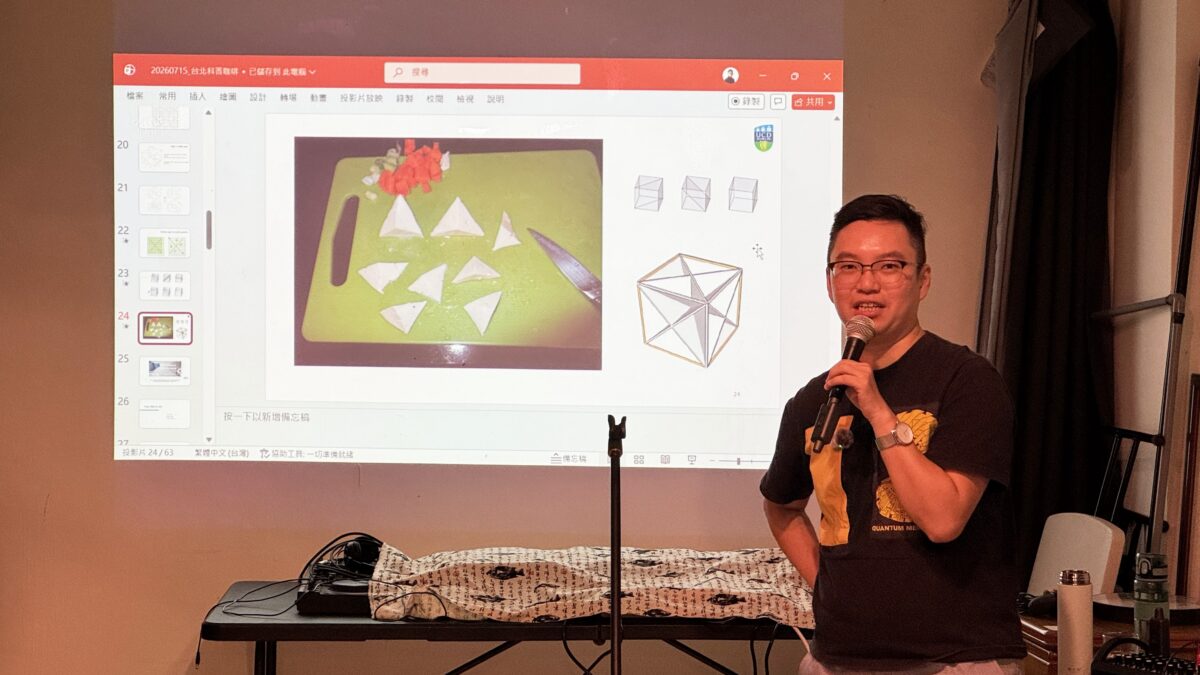
Inspiration can also be found in everyday objects and activities. Sharkie showed a hilarious slide where they happened to buy a block of tofu 豆腐 but started cutting the pieces up into shapes to mock up their Vedic Cube project. The audience ate it up — especially at the joke about Sharkie getting a nice meal out of that moment, too.

Bring Physical Examples
Of course, with a topic like math art and geometry, physical models are so helpful. Sharkie brought smaller models of their Vedic Cube and Vedic Sphere artworks, and passing these around the audience made for a tangible connection to a seemingly intangible world of numbers and equations.

Stay tuned for more of my observations from past and upcoming speakers! And my gratitude to Han-wen Chang 張瀚文 and iesResearch for the encouragement to write up these great ideas to share. See you all around Taipei, and tag me on LinkedIn with your own great science communication 科普 examples of the above principles!