Ben Young Landis 楊政達
August 26, 2026
What are some classic #SciComm #科普 principles we can all keep in our toolkit? As a science communication professional who organizes science café events, I am always noticing moments of brilliance from our speakers.
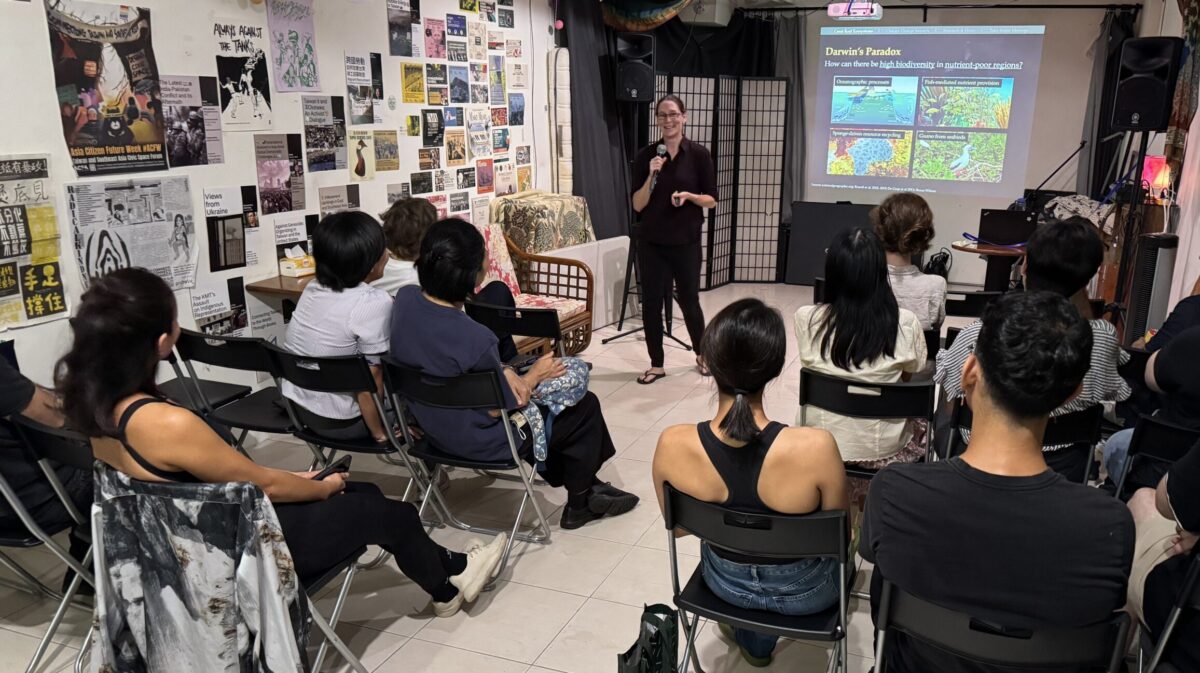
Here are my three observations from our recent Taipei Science Café 台北科普咖啡 hosted at DAYBREAK 破曉咖啡 by New Bloom (www.instagram.com/taipeisciencecafe) — featuring 國立中山大學 National Sun Yat-Sen University (NSYSU) professor Crystal McRae (mcraemarinelab.weebly.com), who delighted us on the topic of Corals 珊瑚:
Find Metaphors and Analogies
“Find Metaphors and Analogies” is actually a section in my “Connecting with Your Audience” workshop slides, so it excited me to see great scicomm examples in Crystal’s August 19 talk.
When discussing ocean acidification and how this climate change outcome changes how corals grow their calcium carbonate skeleton, Crystal told our audience that this was like our “bones getting weaker, versus smaller.” To me, this was a great analogy that connects directly with individual knowledge about their own bodies, something immediately relatable for anyone in the audience. It’s also a great, short quip that is easy to remember and repeat.
In another part of her talk, Dr. McRae also used the “size comparison” scicomm trick when coral “larvae” and their size. “If you’ve ever picked off fleas off of a dog or cat, coral ‘larvae’ are about that same size,” explained Dr. McRae. Even if an audience member had never had that experience, it’s still easy enough to imagine fleas as being quite small to the human eye. (Smartly, Dr. McRae also chose to call this coral life stage by a less technical but more easily remembered term of “larvae” rather than planula, their technical jargon. Another helpful trick.)

Bring It Home
“Think Hyperlocally” is another slide in my “Connecting with Your Audience” workshop, so let’s see how Crystal uses this scicomm trick to great effect.
In discussing coral bleaching, Crystal showed a series of photos depicting the bleaching progress of one coral head over a short period of time. She intentionally left out their geographic context, which teed up her mic-drop moment in her next sentence: “These aren’t some photos I got from Google — these are photos from my favorite reef in Taiwan.”
This specific sentence construction hit our audience immediately. It shocked us that these weren’t coral from some faraway seas, but right here in our home waters. Not only that, these were Crystal’s favorite reef in Taiwan. Whether or not we have ever scuba-dived, the statement right away imparted an emotional quality to this underwater scene. It helps the audience realize that this patch of ocean bottom wasn’t just a place that Crystal studies as a scientist, but a place she admires as a fellow human being.
Other slides Crystal showed also name-dropped frequently heard tourist hotspots, showing bleaching off the island of 小琉球 Xiaoliuqiu, or how the coral ecosystem of 墾丁 Kenting creates valuable ecosystem services, enticing tourism dollars to this rural region. Another photo showed a constructed sea wall made up of concrete “tetrapods” — those giant caltrop-shaped structures often seen around Taiwan’s coasts. Crystal used this as a effective counterexample of what society would have to spend even more valuable time and funding on, if we didn’t have coral reefs as our natural infrastructure to shelter us from storm surges and other powerful impacts.

Ways to Engage and Participate
Scientific research are often endeavors that require a high bar of expertise, finances, and time to participate in, making community science projects extremely valuable public engagement efforts when done correctly. But how can audiences participate in something as exotic as coral conservation?
Professor McRae closed her talk on a hopeful note by promoting her Delta Coral Large-Area Imagine Hub (LAI Hub), part of her lab at NSYSU in 高雄 Kaohsiung. This coral photogrammetry workshop provides computer stations and software where thousands of coral reef photos taken in the wild can be stitched together to create detailed, 3-D models, which can serve as virtual time capsules allowing researchers to compare reef condition over time.
What’s different about “the Hub” is that community members are welcome to visit and get trained, for free! Professor McRae encouraged the audience, inviting opportunity for experienced scuba divers who enjoy underwater photography and wanted to learn how to take images for coral photogrammetry. “You can be the guardian of that reef,” said the professor of anyone who wanted monitor their own favorite patch of coral in Taiwan, year after year, and send that data to the Coral LAI Hub.
But non-divers are also welcome, since Professor McRae invited anyone interested in learning and operating the image-stitching software to come help out (you just have to know how to work a computer). By offering volunteering and free training opportunities at two very different entry points, Professor McRae has created enticing opportunities to participate in scientific research — research that could inform government policy and conservation knowledge here in Taiwan and beyond.

Stay tuned for more of my observations from past and upcoming speakers! And my gratitude to Han-wen Chang 張瀚文 and iesResearch for the encouragement to write up these great ideas to share. See you all around Taipei, and tag me on LinkedIn with your own great science communication 科普 examples of the above principles!